Microfibre is one of the popular couch fabrics in Australia — and one of the misunderstood when it comes to cleaning. The same properties that make it soft and stain-resistant also make it extremely easy to damage with the wrong method.
Use the wrong cleaner and you get watermarks worse than the original stain. Use heat when you shouldn’t and you flatten the nap permanently. Use water on a solvent-only couch and you get shrinkage. This guide tells you exactly what to use for your specific couch, in what order.
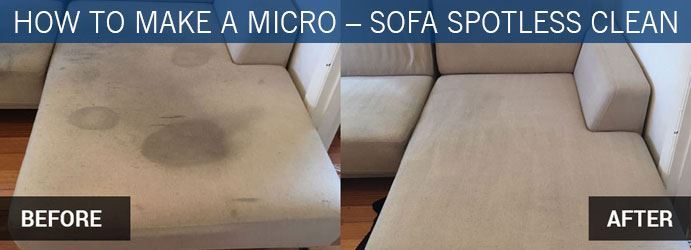
Why Microfibre Cleans Differently from Other Couch Fabrics
Microfibre (also marketed as microsuede or ultra-suede) is made from ultra-fine synthetic fibres — typically polyester or nylon — that are 1/100th the diameter of a human hair. Those micro-sized fibres create a massive surface area that traps particles, which is why the fabric is so soft and effective at catching dust and pet hair. But that structure also means:
- Water-based cleaners leave rings — capillary action draws moisture outward from the application point as it evaporates, leaving a visible halo at the edge of the wet area
- Over-wetting pushes stains deeper — excess liquid carries the stain further into the fibre matrix rather than lifting it
- The nap flattens under pressure — aggressive scrubbing compresses the micro-fibres permanently; they need mechanical lifting with a brush while still damp
- Many microfibre lounges are coded S — meaning no water at all; a water ring on S-coded microfibre is extremely difficult to remove
Microsuede vs microfibre: Essentially the same material — ultra-fine polyester or nylon fibres — just marketed differently. “Microsuede” usually refers to microfibre brushed to create a suede-like texture. The cleaning rules are identical.
Step Zero: Find Your Fabric Care Code
This is the single important step. Find the tag under a seat cushion, on the inside of a removable cover, or on the rear panel frame.
| Code | Meaning | Safe Cleaners |
| W | Water-based cleaners only | Mild detergent foam, vinegar solution, carpet cleaner, steam |
| WS | Water or solvent — flexible | Water-based cleaners AND alcohol/dry-cleaning solvents |
| S | Solvent only — NO water | Isopropyl alcohol 70%+ or dry-cleaning solvent only |
| X | Vacuum only | No liquids. Call a professional for stains. |
If the tag is missing: Do a water droplet test on a hidden area. If the drop beads and doesn’t absorb within 30 seconds → treat as S-coded. If it absorbs immediately → treat as W-coded. Always do a full patch test before applying any cleaner to a visible area.
Before You Start: 3 Non-Negotiable Prep Steps
- Vacuum thoroughly — every surface, every seam. Upholstery attachment, armrests, cushion creases, under removable cushions. Dry debris pushed into fibres by liquid cleaning creates grinding particles that damage the nap and permanently embed dirt.
- Patch test your cleaner on a hidden spot. Under a seat cushion flap or on the rear base panel. Apply, wait 5 minutes, check for colour change, watermarks, shrinkage or fibre damage. This step takes 5 minutes and can save an expensive couch.
- Have a stiff dry brush ready before you start. The single important tool for microfibre cleaning isn’t the cleaning solution — it’s the brush you use while the couch is drying. Brushing fibres back up in circular motions while the fabric is slightly damp restores the nap and prevents the flat, stiff feeling that people associate with “cleaned microfibre.”
5 Proven Cleaning Methods
Method 01 — Rubbing Alcohol (Best for S-Coded and Most WS Microfibre)
Best for: S and WS coded microfibre couches Avoid on: Acetate/triacetate blends — alcohol can dissolve these fibres
Isopropyl alcohol at 70% is widely regarded as the professional all-purpose microfibre cleaner. It dissolves common stain types, evaporates quickly without water rings, and lifts the fibres when combined with brushing. For S-coded microfibre, it’s the only safe DIY option.
What you need: 70% isopropyl alcohol · Spray bottle · Multiple clean white cloths · Stiff dry brush
Process:
- After vacuuming and patch testing, spray isopropyl alcohol lightly onto the dirty area. Don’t saturate — the fabric should be damp, not wet.
- Using a clean white cloth, rub in small circular motions with light pressure.
- Change to a fresh cloth section as soon as it picks up visible grime.
- For spot stains, work from outside the stain inward.
- While the fabric is still slightly damp, use your stiff dry brush in firm circular motions to lift and restore the fibres.
- Allow to air dry completely — approximately 15–20 minutes.
- Final dry brush pass to complete nap restoration.
Pro Tip (not in standard guides): Most cleaning guides push water-based solutions. Experienced upholstery solutions default to 70% isopropyl alcohol on microfibre for virtually every job — including W-coded couches — because the lack of water eliminates the watermark risk entirely. The alcohol lifts the stain into the cloth and evaporates clean. The key: use the stiff brush while the alcohol is still slightly present. The result looks professionally cleaned. This two-step combination (alcohol + brushing while damp) is not mentioned in any mainstream cleaning guide.
Method 02 — White Vinegar Solution (Budget Option, W and WS Coded)
Best for: Light food stains, general grime, odour on W/WS microfibre Never use on: S-coded fabric — the water content causes permanent watermarks
Mix 1 part white vinegar + 2 parts water + a few drops of dish detergent. Apply to a clean white cloth — not directly to the fabric. Wipe in the direction of the nap. Follow immediately with a second cloth barely dampened in clean water to rinse the vinegar residue. Blot dry. Brush the nap while still slightly damp. Fan-dry for 1–2 hours.
Method 03 — Dish Soap Foam (General Deep Clean, W/WS Coded)
Best for: Full lounge suite clean — not just spot treatment
The key is using the foam, not the liquid. Liquid applied directly over-saturates the fabric. Foam sits on the surface, loosens dirt without pushing it deeper.
- Whisk warm water with 2–3 drops of dish detergent until you have stable foam. Use only the foam head.
- Apply foam section by section with a sponge or cloth.
- Work in circular motions — extra attention on armrests, headrests and seat creases.
- Wipe away foam with a barely-damp cloth (thoroughly wrung out).
- Follow with a dry cloth to remove remaining moisture.
- Brush each section while still slightly damp.
- Fan-dry the entire couch for 2–3 hours with windows open.
Method 04 — Baking Soda (Deodorising and Oil Absorption)
Best for: All microfibre types — dry application is safe on S-coded fabric Works on: Pet odour, food smell, tobacco, light grease absorption
Sprinkle baking soda generously over all fabric surfaces. Work into fibres with a soft brush. Leave for 2 hours minimum (overnight for heavy odour). Vacuum thoroughly with the upholstery attachment.
For light spot stains: mix baking soda with just enough water to form a paste, apply to the stain, allow to dry completely (3–4 hours), vacuum off. Safe for W and WS coded fabric only — not S coded.
Method 05 — Removable Cover Washing (For Zip-Off Cover Lounges)
Machine wash on cold or delicate cycle (30°C maximum) with liquid detergent — not powder. Turn inside out. Do not tumble dry on high heat. Remove immediately after cycle. Dry flat or hang in a ventilated shade. Refit while slightly damp for a better fit; brush nap while fitting.
Stain-by-Stain Quick Reference
| Stain Type | Best Solution | Key Avoid |
| General grime | Isopropyl alcohol 70% | Over-wetting |
| Food stains (light) | Vinegar solution or dish foam | Hot water |
| Grease / cooking oil | Baking soda absorption first, then alcohol | Liquid cleaner first |
| Red wine (old) | Bicarb + 3% hydrogen peroxide paste | Hot water, scrubbing |
| Coffee / tea | Vinegar (W/WS) or alcohol (S) | Hot water sets tannins |
| Ink | Isopropyl alcohol via cloth — blot only | Water sets ink |
| Pet urine (fresh) | Blot immediately + enzyme cleaner | Steam (sets odour) |
| Pet urine (old) | Enzyme cleaner — 15–20 min contact | Vinegar alone insufficient |
| Blood | Cold water + baking soda paste (W/WS) | Warm/hot water |
| Chewing gum | Freeze, scrape, then alcohol | Pulling while warm |
| Nail polish | Non-acetone remover or alcohol | Acetone on synthetic fibres |
| Sunscreen | Baking soda first, then alcohol | Water (spreads oil) |
| Sweat / yellowing | Bicarb + hydrogen peroxide paste | Hot water |
| Mould | Vinegar (W/WS) or alcohol (S) — 10–20 min contact | Steam before killing mould |
How to Deodorise a Microfiber Couch That Smells?
General odour (food, sweat, mild pet smell): Baking soda generously applied, worked into fibres, left overnight, vacuumed off. Follow with a light spray of undiluted white vinegar to neutralise any remaining odour compounds as it dries.
Heavy pet odour (urine specifically): Enzyme cleaner only. Baking soda and vinegar cannot break down uric acid crystals. Use a product containing protease and urease enzymes (Biozet, Nature’s Miracle, or similar). Full 15–20 minute contact time. Blot dry. Fan-dry thoroughly. Never steam pet urine — heat permanently bonds uric acid crystals to the fibres.
How to Restore a Flat or Stiff Microfiber Couch?
If your couch looks flat and rough after cleaning, the nap dried compressed without brushing. To restore:
- Lightly mist the stiff area with water (W/WS coded) or isopropyl alcohol (S coded)
- Immediately use a stiff-bristle brush in firm circular motions
- Continue brushing until the area feels soft and even
- Fan-dry while brushing every 10–15 minutes
Pro Tip: Use a clean rubber dishwashing glove in circular motions over the fabric. The mild friction creates static that lifts the microfibre nap and restores the “just-bought” plush appearance. This is the same principle as a lint roller on velvet — static lifting. Combined with brushing, this makes a dramatic visible difference on older, flattened microfibre.
Carpet Cleaners and Steam Cleaners on Microfibre
Carpet / Upholstery Cleaner
- W and WS coded microfibre only — never S coded
- Use upholstery attachment, not carpet head
- Low-moisture extraction mode
- Diluted upholstery shampoo, not carpet formula
- Brush nap immediately after, before fully dry
- Fan-dry 3–4 hours minimum
Steam Cleaner
- W and WS coded microfibre only — never S coded
- Handheld garment steamer, slow overlapping passes
- Keep head 3–5cm from surface
- Never steam old pet urine stains
- Brush nap immediately while fabric still warm
7 Mistakes That Cause Permanent Damage
- Using water on S-coded microfibre. The watermark is very difficult to remove. Recovery: dampen the entire cushion evenly and brush/fan-dry uniformly.
- Spraying cleaner directly onto the fabric. Always spray onto the cloth, not the couch.
- Scrubbing instead of blotting. Aggressive rubbing pushes stains deeper and spreads them laterally. Use gentle circular motions.
- Not brushing while drying. The nap direction is set during drying. Missing this window requires re-wetting and repeating the process.
- Using bleach on any microfibre. Bleach degrades synthetic polymer fibres, permanently changing the colour and weakening the structure.
- Leaving the couch damp in a closed room. Microfibre cushion filling holds moisture for 6–12 hours after the surface feels dry. Mould can establish in the filling within 24–48 hours in warm conditions.
- Using a coloured cloth. Coloured cloths can transfer dye to wet microfibre, particularly light-coloured couches. Always use white cloths.
FAQs
Ques 1. What is the professional way to clean a microfiber couch?
Ans. Check the care code first. W/WS: diluted dish soap foam or white vinegar solution. S coded: isopropyl alcohol 70%+ only. The critical step everyone misses: brush the nap back up with a stiff dry brush while still slightly damp.
Ques 2. How do I clean a microfiber couch without leaving water spots?
Ans. Use minimal moisture; apply to cloth, not fabric; dry immediately with a fan. For S-coded, use alcohol instead — it evaporates without rings. Existing rings: dampen the entire cushion evenly and dry uniformly.
Ques 3. Can you clean a microfiber couch with alcohol?
Ans. Yes — preferred for S-coded and many WS-coded couches. 70% isopropyl alcohol, applied via cloth, rubbed in circles, brushed while drying. Evaporates without water rings.
Ques 4. Can you use a carpet cleaner on a microfiber couch?
Ans. Yes, on W or WS coded microfibre only. Upholstery attachment, low-moisture extraction, diluted upholstery shampoo. Brush nap immediately after and fan-dry 3–4 hours.
Ques 5. Can you steam clean a microfiber couch?
Ans. Only W or WS coded. Handheld garment steamer, slow passes 3–5cm from the surface. Never S-coded. Never on old pet urine. Brush nap while still warm.
Ques 6. How do I make my microfiber couch soft again?
Ans. Mist with water (W/WS) or alcohol (S). Brush firmly in circular motions while still damp. A rubber dishwashing glove in circular motions adds static that lifts the nap further. Fan-dry while continuing to brush every 10–15 minutes.
Ques 7. How do I get stains out of a white microfiber couch?
Ans. Check the care code. For stains: 70% isopropyl alcohol on a white cloth. For stubborn yellowing: baking soda + 3% hydrogen peroxide paste for 15–20 minutes, then blot dry. For red microfibre: patch test peroxide first to check for colour lifting.
Hire Professional Sofa Cleaning Services

Although these tips and tricks can give you temporary relief, for long-term results, taking the help of professional upholstery cleaners Perth becomes necessary. With proper knowledge and skills, they can help you maintain the sofas in the possible manner.
Squeaky Clean Sofa can let you have neat and clean sofas instantly without fail. We are a skilled company with 5+ years of experience and expertise. Moreover, our staff uses reliable methods and methods along with natural, toxic-free chemicals to give your upholstery a new look. All you need to do is give us a call on 0482077285 to get your microfiber sofas new again.
Our Service Areas:-

